

Photo: MD Group
About how domestic embryology laboratories look today, what challenges stimulate industry development, and what prospects Russian developments have, Alexander Yurievich Vysotsky, Head of the Embryology Laboratory at the E.G. Lebedeva Center for Innovative Reproductive Technologies of the MD Group Clinical Hospital of the Mother and Child Group of Companies, told Marus Media in an interview.
Expert Profile
Alexander Yurievich Vysotsky – PhD, Head of the Embryology Laboratory at the E.G. Lebedeva Center for Innovative Reproductive Technologies of the MD Group Clinical Hospital of the Mother and Child Group of Companies. Member of the Russian Association of Human Reproduction and the European Society of Human Reproduction and Embryology. Author of over 15 scientific works on male and female infertility problems.
Education and Qualifications
2000 – Altai State Medical University.
2005 – Defended PhD dissertation on problems of improving infertility treatment efficacy using IVF and ICSI methods.
Professional Experience
Over 20 years in clinical embryology.
2000 – Director of Siberian Institute of Human Reproduction and Genetics.
2008 – IVF embryologist at MD Group Clinical Hospital.
2019 – Head of embryology laboratory at MD Group.
Professional interests: Masters full spectrum of micromanipulation technologies (ICSI, embryo biopsy, assisted hatching); oversees implementation of new technologies and protocols in network laboratories.
Professional skills and scientific interests: Assessment of obtained biomaterial quality: sperm and oocytes; laboratory fertilization; embryo development monitoring; cryopreservation of embryos, oocytes, sperm; laboratory fertilization; creation and control of optimal culture conditions; assisted hatching; preimplantation genetic testing (PGT); improvement of cryopreservation methods (vitrification); implementation of artificial intelligence systems in embryology.
“We Don't Strive for Isolation, Our Goal Is Technological Independence and Cosmopolitanism”
– How would you characterize the current level of Russian ART centers, including your department, against the global market backdrop? In which aspects do we already match leaders, and what still needs work?
– If we consider the technological equipment of leading Russian ART centers, we've achieved parity with European and American clinics on key parameters. However, the current stage is characterized not simply by catch-up development but by formation of a fundamentally new market architecture, where import substitution has become not a forced measure but a driver of technological evolution.
Russian IVF technologies have reached a high level and in many ways match leading European and U.S. clinics. We confidently compete in technical equipment and therapeutic protocols. An important advantage is procedure accessibility for patients thanks to mandatory health insurance programs covering more than half of IVF cycles in the country.
However, in population coverage, our indicator is still below the European standard of 1,500 cycles per million population. This relates to different patient engagement, economic factors, and regional specifics. Infrastructure imbalances persist, and not all regions have yet managed to create world-class laboratories. We're working on standardization and further improvement. But it's important to understand that technologically our leading clinics can perform the full spectrum of modern manipulations and actively participate in professional communities at the ESHRE and ASRM, RAHR level, which promotes constant specialist qualification growth.
A competitive advantage remains relatively low prices. This isn't a consequence of poor quality but historically established pricing logic and high market competition. Consumable and equipment quality in leading centers meets global standards.
– How dependent are Russian clinics on drugs, imported equipment, and consumables? How do you solve related challenges?
– The main part of specialized equipment and biological media was previously supplied from Europe, the USA, and Japan – countries that imposed sanctions. This undoubtedly created difficulties. However, in recent years the situation has changed significantly: we successfully implemented Russian ovulation stimulation drugs – gonadotropins, domestic cell culture media, and Russian incubators with characteristics matching Western analogs appeared. Now, as far as I know, work is actively underway on incubators with time-lapse monitoring. We don't strive for isolation; our goal is technological independence and cosmopolitanism. Creating the laboratory, we laid infrastructure allowing powering any equipment in the world. This gives us freedom of choice – to work with the best systems, regardless of their origin.
Three main pillars – how to obtain cells, where to place them, and what to grow them in – this is the import substitution path we're now successfully following. And I think if significant progress occurred over several years, then in the future we have every prospect of being independent from the supplier market.
Additionally, new partnerships with Asian manufacturers have opened and are developing, particularly from China, which has rapid ART technological segment growth, and AI monitoring systems are actively developing. We cooperate and test their solutions. We can say that for us current challenges became a stimulus for import substitution and supplier diversification, which laid the foundation for technological independence.

“Embryologists Are Prohibited from Using Deodorants and Perfumes”
– Tell us about your embryology laboratory's work and equipment. What equipment do you consider critically important for success?
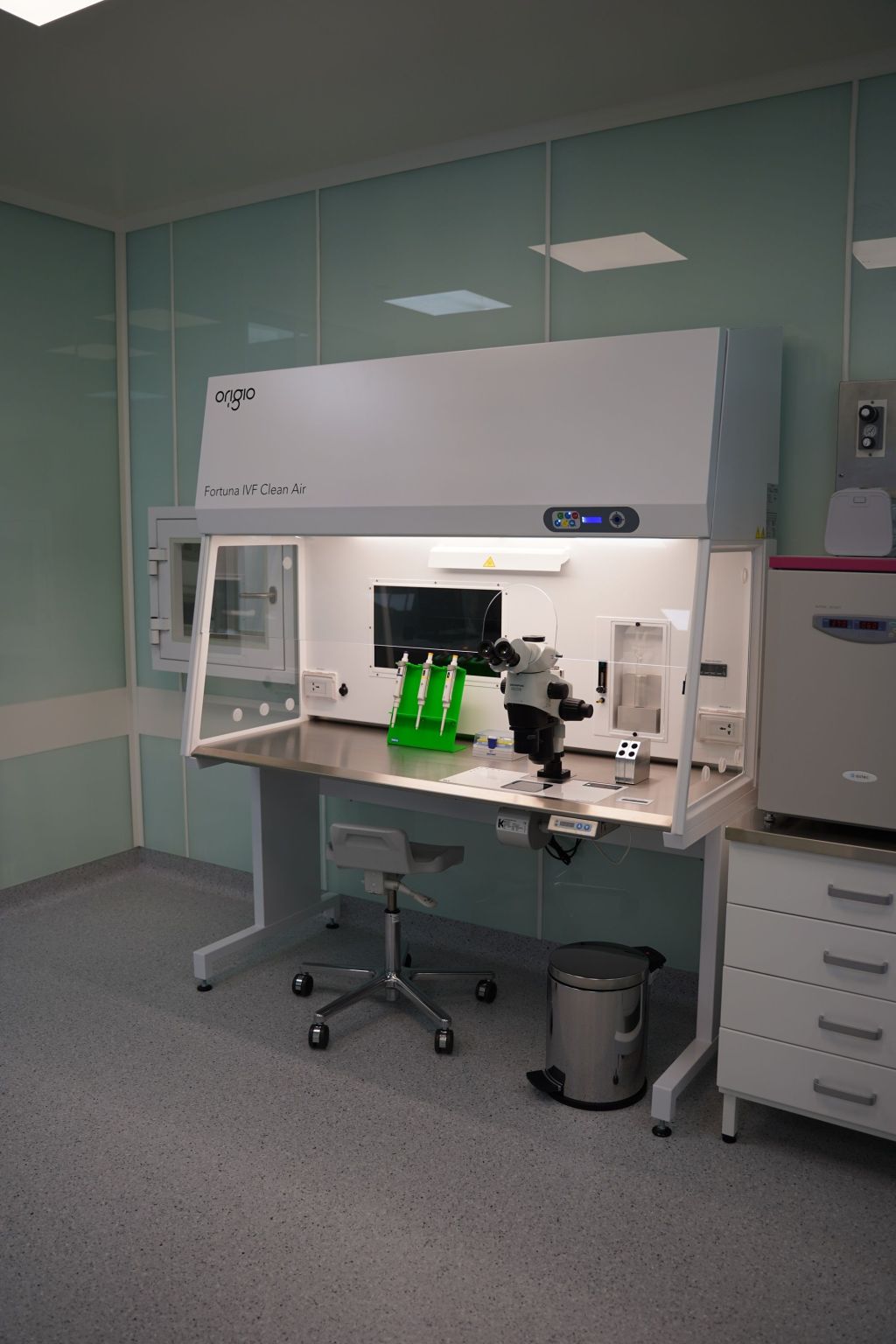
– Any laboratory and, consequently, this laboratory's success depends not only on equipment but on the facility's design itself. The foundation of success is a combination of conditions: from facility conditions to equipment and highly qualified personnel. Our laboratory is a fundamentally new facility meeting regulatory requirements. This is a facility with controlled physical factors, and I'm not just talking about sterility. Besides sterility, reduction and absence of viral and bacterial load, there must be a special temperature regime and electrical safety. Switching between backup power sources shouldn't cause voltage spikes. And most importantly – in the room where embryos are cultured, there must be a certain humidity level.
Our center built a laboratory with controlled physical parameters: stable temperature, humidity, and – critically – air quality are maintained. We use specialized filters to remove volatile organic compounds (VOCs), meaning harmful impurities – any substances from ethyl alcohol to formaldehydes, and dust particles, which excludes harmful substance contact with embryos. Why this is so important: embryologists are prohibited from using deodorants and perfumes – everything that smells, all volatile compounds that can dissolve in the environment where our embryos are located, are harmful. The laboratory is equipped with specialized filters that destroy all substances, and air enters purified from dissolved odors and particulate elements. The laboratory operates with positive pressure – this prevents contaminated air from penetrating inside.
Its appearance is also interesting – shaped like a transparent glass cube resembling a spaceship – everything can be examined without entering. We wanted to create a laboratory meeting standards even 10, 20, 30 years from now. This is our reserve and safety margin.
For successful laboratory operation, optimal patient-to-incubator ratio is important – this is key to successful embryo cultivation: each patient should be allocated an individual incubator culture compartment to exclude frequent door opening, mixing, and embryo stress, ensuring stable and maximally natural development conditions.
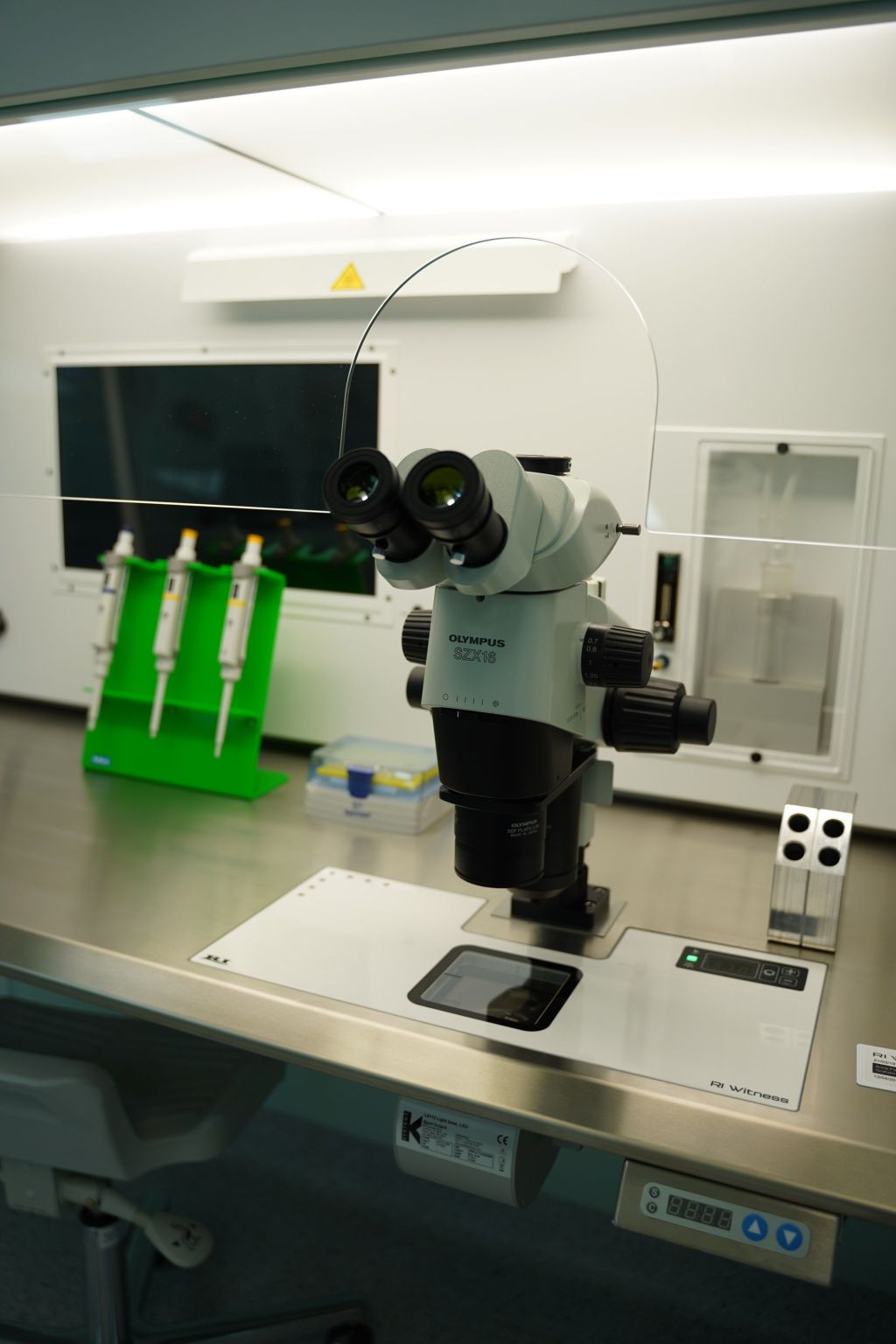
Another key factor for successful embryology laboratory operation is sufficient workstations – specialized laminar flow cabinets where the embryologist performs all necessary manipulations with oocytes, zygotes, and embryos. Each such station ensures special cleanliness through filtered air and maintains optimal temperature on heated surfaces, equipped with a microscope for careful observation and manipulations. All manipulations cannot be performed in one station.
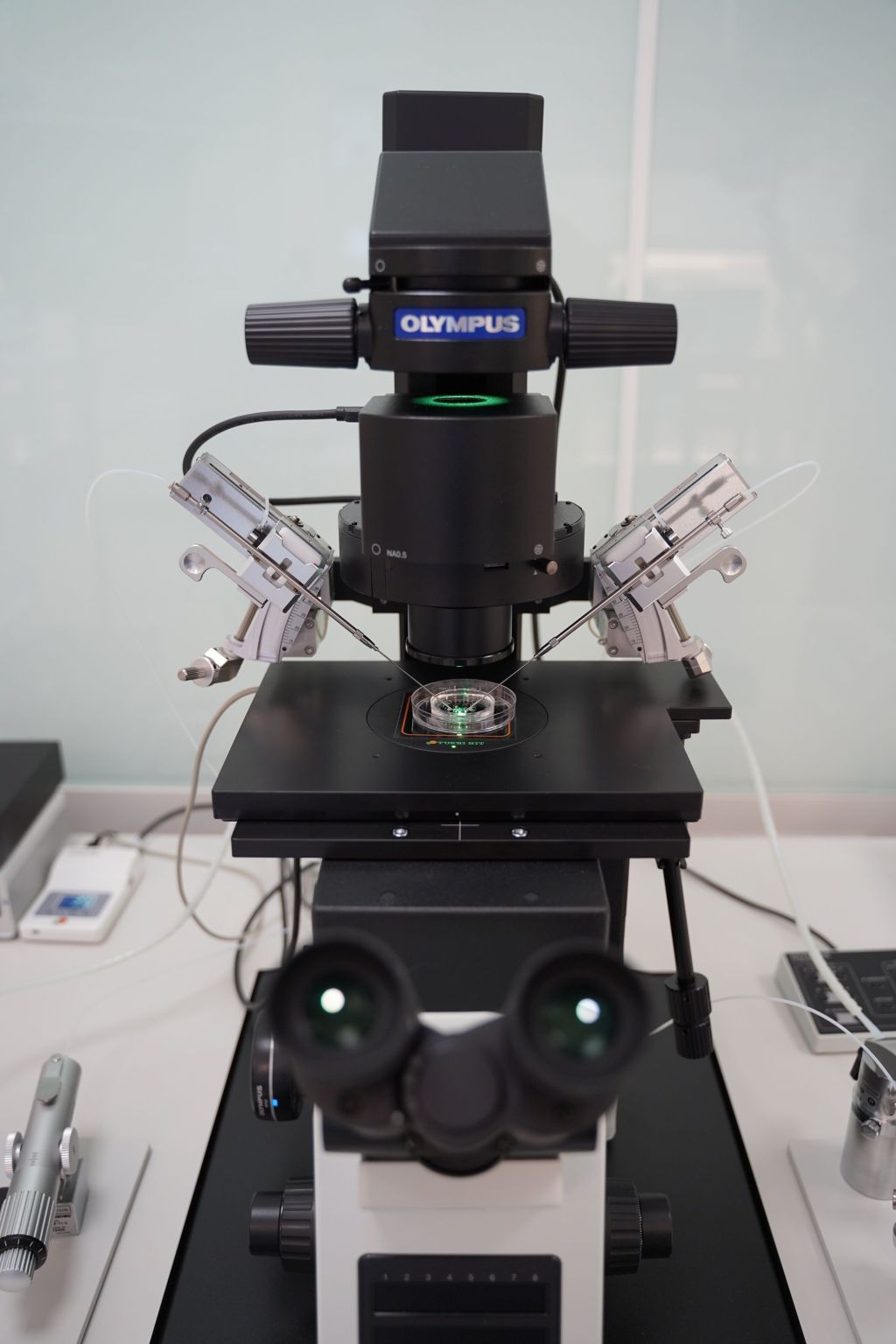
Another important thing is microscopes with manipulators possessing high-quality optics, which leading manufacturers have at approximately the same level. The main requirement – they must be located in a clean zone and maximally protected from external vibrations and oscillations. For this, special anti-vibration tables are used, originally developed for telescope optics installation. They don't simply dampen but apply the piezo-pulse principle: when external vibrations appear, counter-waves are created that suppress these oscillations. This is critically important for precise, quality embryo manipulations.
Regarding incubators, significant differences truly exist between different models and generations. Old models resemble cabinets maintaining only three main parameters: temperature, humidity around 100%, and carbon dioxide level – it regulates medium acidity (pH). However, opening such an incubator's door caused substantial microclimate disruption, and several hours were required to restore conditions. Modern second-generation bench-top incubators allow restoring environmental parameters in 30–60 seconds.
They additionally control oxygen concentration through nitrogen supply, allowing creation of maximally natural embryo development environment. Modern incubators are divided into several types. The first are single-chamber CO2 incubators, resembling familiar household refrigerators, maintaining only three parameters: temperature, humidity around 100%, and CO2 level.
In such models, due to door opening, significant microclimate disruptions occur requiring lengthy restoration time. The second generation are bench-top incubators where the environment is restored in seconds. They allow controlling oxygen level, which is especially important, since reducing oxygen concentration using nitrogen accelerates processes inside the incubator and creates more physiological conditions for embryo development.

“There Are No 'Bad' Embryos – There Are Embryos with Greater or Lesser Potential”
– Do you use incubators with continuous monitoring (time-lapse) and how do they affect results?
– In our practice we use both classic incubators and modern time-lapse monitoring systems, which allow observing embryo development in automatic mode, avoiding intervention and door opening. Time-lapse system incubators provide additional advantage – continuous video monitoring of embryo development without environmental intervention: the camera periodically takes photographs from which sequential video of embryo growth and division is formed. This allows remote process control and provides opportunity to apply artificial intelligence and neural network methods for multifactorial mathematical analysis evaluating parameters such as cleavage timing and blastocyst formation.
All embryo development events can be described mathematically – first, second, and third cleavage timing, blastocyst formation timing, and time interval ratios. There's a special assessment system – viability potential index of biological material, meaning embryos. These indices are based not on empirical data but on analysis of a large array of registered successful pregnancy cases. Each new embryo development is compared with this array, the KIDScore system (Known Implantation Data) – data on known implantations.
This array is constantly updated: at work's beginning the database contained about 150–200 thousand pregnancies, and today the case number has grown significantly, allowing more accurate assessment data. The resulting embryo viability potential index is based on a huge array of real pregnancy data regularly updated, allowing identification of embryos with greatest pregnancy potential. It's important to understand that "bad" embryos don't exist – there are embryos with greater or lesser potential.
Such AI systems are developing not only in Russia but globally, and they allow digitizing complete embryo history in the first 5–7 days of development, after which the embryo's further fate depends on cryopreservation storage or uterine cavity transfer.
– Laboratory culture conditions are often called "artificial." How close are they actually to the natural environment in a woman's body?
– The main thing is ensuring stable conditions maximally approximating natural ones and creating conditions where embryo development is maximally favorable. In general, the incubator and conditions created in it strive to maximally imitate the natural environment of a woman's body, mainly – the internal environment of the fallopian tubes, where fertilization and initial embryo development stages occur. Reproducing these conditions is the embryology laboratory's main task, since optimal homeostasis and environmental parameters for embryo development form precisely in the fallopian tubes.
Despite the fact that each woman and her body are unique and have their own characteristics, the laboratory creates an averaged but maximally physiological and stable microclimate ensuring cell development. The main parameters are temperature, gas composition, humidity, and biological fluid with complex organic substances and microelements. Such an artificial environment allows reproducing the natural fertilization process and egg cell division with high accuracy.
“It's Important Not to Confuse Physical Wear with Moral Obsolescence”
– How many incubators should there be for successful operation?
– The number of incubators depends on laboratory volume. According to 2002–2005 embryology recommendations, one should start with 3 incubators at loads up to 300 cycles per year, adding one incubator per each additional 100 cycles. When cultivating using time-lapse system, it's important to consider patient numbers per year and month. For example, with 150 patients per month and 150 IVF cycles, simultaneously 15–20 patients will be in incubators. The EmbryoScope system includes 15 compact cells, so 2 such devices are sufficient to cover needs. For ordinary bench-top incubators with two compartments each, with 20 patients simultaneously, having 8 to 10 incubators is optimal to ensure quality material cultivation and not create congestion and frequent door opening conditions, which disrupt microclimate.
MD Group Embryology Laboratory Organization and Equipment
MD Group embryology laboratory is a modern facility designed considering multi-component requirements.
Key embryo cultivation parameters:
- Temperature accuracy ±0.2°C, humidity 95–100%.
- Gas mixture with CO2 6%, oxygen 5%, imitating fallopian tube environment.
- Multi-stage air purification with HEPA and carbon filters for particle and VOC removal.
- Positive pressure to prevent external contamination.
Technical capabilities:
- Special clean rooms with controlled physical parameters and highly purified air.
- Separate zone for preimplantation diagnosis stages.
- 2 EmbryoScope incubators with Time-lapse system for continuous embryo monitoring and video data recording.
- 6 classic-design incubators.
- 12 bench-top CO2 incubators with rapid environmental parameter recovery after opening (within 1 minute).
- Specialized microscopes with micromanipulators for ICSI and biopsy.
- Anti-vibration optical tables with piezo-pulse oscillation damping.
- Workstations with laminar flow cabinets for sterile manipulations.
- Equipment for embryo vitrification and thawing.
– How often does equipment require updating?
– In laboratory practice, equipment service life is strictly regulated, and the main guideline is the manufacturer-established maximum service life. It's important not to confuse physical wear with moral obsolescence. Much like aircraft that can serve decades while remaining fully serviceable, in laboratories equipment can be used long if it regularly undergoes technical maintenance and verification.
Most important is observing regulated technical maintenance schedules – timely component replacement and calibration allow maintaining instruments in current condition. Optical instruments like microscopes, with proper care, work for decades without quality loss, and their premature replacement is inexpedient. The main criterion is equipment compliance with modern standards and safety requirements, not simply calendar service life.

“A Physician Perceives an Embryo Not as a Biological Model, But as a Little Patient”
– Tell us about the person who directly works with embryos. What's unique about embryologist training in Russia compared to the world?
– In most countries worldwide, an embryologist is, first and foremost, a biologist. Such an answer seems obvious to many patients and clinics around the world. However, in Russia this profession has its specifics: both a biologist and a physician can become an embryologist. So is this a medical specialty or biological? Both paths have their strengths. Fundamental biological education is undoubtedly extremely important. Knowledge gained at biology faculty helps deeply comprehend all processes, including biochemical ones, underlying our work, which I call clinical embryology. However, physicians have another equally important advantage – a special mentality, and I consider this a plus. A physician initially perceives an embryo not as a biological model but as a little patient. Moreover, they possess deep understanding of the overall clinical picture: woman's cycle characteristics, possible extragenital problems. A competent embryologist must understand stimulation and hormonal monitoring issues, participate in their discussion, find patterns between what they see at cellular level and the patient's clinical condition. They shouldn't be confined only to the laboratory.
Thus, biologists have fundamental knowledge of all biological science, from microbiology to ultrastructural research. And physicians have involvement in clinical understanding not only of the laboratory stage but the entire IVF cycle as a whole. In our laboratory, by the way, mainly physicians work.
– If reproductive specialist and embryologist are the classic tandem, what role does the geneticist play in this team today and why can't they be replaced by other specialists?
– Regarding genetics, its basics should be familiar to all IVF specialists. However, any cycle with genetic diagnosis, according to modern clinical recommendations, must be accompanied by clinical geneticist consultation.
In the 90s there was a trend toward universalism, when one physician strived to cover everything. The first Russian embryologists who began work after the first IVF baby's birth in the USSR in 1986 deserve enormous respect for their titanic work. I was fortunate to work with Lyudmila Viktorovna Khilkevich – one of Russia's first embryologists who, under Boris Vasilyevich Leonov's guidance, together with the pioneer group in our field, stood at the origins of IVF development in Russia, including the birth of the country's first IVF-conceived child. Stories when one person consulted, cared for biological cultivation moments, and modeled stimulation cycles deserve respect. But today the standard is teamwork.
The classic pairing is reproductive specialist and embryologist. The third key link I'd name is the geneticist, whose role is becoming increasingly significant. Following are anesthesiologists, nurses, and laboratory assistants.
Clinical geneticist consultation is necessary for interpreting complex data, whether compiling a genealogical tree or analyzing spouse karyotypes, especially when hereditary pathologies are suspected. This is complex, highly specialized work into which non-profile specialists shouldn't interfere. Today worldwide, and Russia is no exception, a separate direction even emerges – consultation with a geneticist specializing in PGT issues.

“The Embryologist's Work Doesn't End at Transfer Moment, Since Cultivation Quality Directly Affects Embryo's Further Potential”
– How are biomaterial safety and identification ensured?
– The laboratory uses double biomaterial marking – this minimizes errors at all stages: from oocyte retrieval to cultivation, biopsy, and cryopreservation. All processes are accompanied by electronic protocol with documentation of each stage. This is a mandatory standard implemented at our laboratory level and meets international requirements.
– Tell us about your center's statistics: pregnancy rates, cryopreservation, and successful thawing indicators.
– If we're talking about our center's statistics, I'll start with the embryology part – this is my area of responsibility. We're talking about specific numbers and parameters that every embryology laboratory head must track daily. These parameters are regulated by international standards such as the Vienna and Maribor consensuses. How were they formed? Researchers collected a huge data array from many clinics worldwide. Differences were considered: somewhere results were better, somewhere worse, somewhere there was specific age contingent or high percentage of donor cell use. Then these "extreme" points were cut off, indicators averaged, and threshold values derived – upper and lower boundaries. If your results are in this "corridor," you can be confident the system works stably. If some indicator "drops" – this signals the problem lies either in patient clinical preparation or in the laboratory's work itself.
What are these key parameters?
- Mature oocyte proportion. How many viable eggs do we obtain?
- Fertilization rate. Human biology is such that about 75% of mature cells should fertilize. One hundred percent result cannot exist in principle – such is the mechanism laid down by nature.
- Embryo proportion developed to transfer/freezing. And here we won't get 100%. On average, from 40% to 60% of fertilized cells grow to quality embryo stage. If the indicator is 45% – causes need analyzing (patient age, accompanying diagnoses). If it exceeds 60% – this is an excellent result, but it's also worth studying: perhaps this month there was simply a young contingent.
We track the entire chain: from cell retrieval to pregnancy onset and carrying. The embryologist's work doesn't end at transfer moment, since cultivation quality directly affects embryo's further potential. There's even a concept of "suboptimal cultivation" – when pregnancy occurs but terminates early due to problems possibly laid at the laboratory stage.
The main IVF success criterion is not just a positive test but a healthy baby's birth. Therefore the most honest and main success parameter in the world community is called "take-home baby rate" – live birth rate per one started IVF attempt.
Here it's important to understand the statistics difference. Often clinics operate with the "pregnancy per transfer" indicator. It can be high, but it doesn't account for all patients who entered the cycle. For example, out of 100 women, only 50 may reach transfer. And if of these 50, pregnancy occurred in 25, then formally effectiveness is 50%. But where did the other 50 go? They didn't respond to stimulation, their eggs didn't fertilize, or embryos stopped developing.
More objective is the "Intention to Treat" (ITT) calculation – intention to treat, meaning accounting for results for each woman who entered the protocol. These figures are undoubtedly lower, but they reflect the real picture. One shouldn't fear or be ashamed of these data. Our task isn't chasing fairy-tale 100%, which doesn't exist in human biology, but honestly analyzing statistics, identifying weak points, and constantly working to improve care quality at all stages.
In our practice, pregnancy rate per one embryo transfer is at the level of 55–60% in patients under 35 years and from 30% in women over 40. Biomaterial preservation percentage is very high, for oocytes it exceeds 95%, for embryos – over 99%. Successful thawing is accompanied by high viability indicators, allowing biomaterial quality preservation.

“Embryo Death from Properly Conducted Freezing Is an Extremely Rare Case”
– With overall statistics clear, how is cryopreservation success assessed? By what criteria can one understand that freezing and thawing proceeded successfully?
– Cryopreservation isn't just a technical stage but a true "lifesaver" of modern reproductive medicine. While everyone talks about genetics and time-lapse systems, freezing's significance is often underestimated. Meanwhile, this is truly a great technology perfected through scientists' work, including Japanese researcher Masashige Kuwayama.
Vitrification, or ultra-rapid freezing, made a real revolution. Previously, before its appearance, the attitude toward freezing was different. An opinion prevailed: "Better transfer more embryos at once than risk freezing." But this is a misconception. The embryo won't be "better" in the mother's body if her hormonal background is disrupted after stimulation, if there are signs of ovarian hyperstimulation, or if the endometrium isn't ready for implantation.
Vitrification radically changed the game rules. Today embryo death from properly conducted freezing is casuistry, an extremely rare case. Survival exceeds 99%. Moreover, paradoxically, cryo-transfer effectiveness often proves higher than in fresh cycles. The explanation is simple: we don't improve embryos during freezing. The embryologist's task is not to spoil, to preserve their viability. Vitrification allows doing this impeccably. And most importantly – it gives time. Masashige Kuwayama figuratively called it a "pause button."
This "pause button" allows:
- Postponing transfer if the woman becomes ill.
- Conducting embryo genetic diagnosis.
- Waiting for ideal endometrial condition when the patient's body fully recovers after hormonal stimulation and puncture.
We can transfer an embryo in a natural cycle when the body is maximally ready for pregnancy, not under hormonal "storm" conditions. Effectiveness naturally grows.
Therefore, evaluating laboratory work, I always ask two key questions: "What's your pregnancy rate in fresh cycles?" and "And in cryo-cycles?" If the answer to the second question is higher – this is a sure sign of high laboratory work quality. If freezing reduces effectiveness – this is an alarming signal.
Thus, today up to 80% of our cycles end with cryopreservation. And I always explain to patients: vitrification shouldn't be feared. This is a reliable and powerful tool that doesn't harm embryos but, on the contrary, increases your chances of successful pregnancy under optimal conditions.
– Tell us about factors affecting IVF success.
– To summarize, IVF success is always the result of coordinated work of two key links. It's pointless to argue who's more important – the reproductive specialist conducting stimulation or the embryologist responsible for cultivation. Their contribution is equal and absolutely irreplaceable.
Clinical stage:
- Competent stimulation selected considering patient's age and ovarian reserve.
- Adequate protocol choice (long, short, natural cycle).
- Correct drug selection.
Embryological stage:
- The embryologist's task is not to spoil but to fully realize germ cell potential. Any suboptimal conditions – temperature spikes, unstable gas composition, low-quality media – are unacceptable and indicate systematic failure in laboratory work.
- Cultivation success consists of:
- Physical factor stability: uninterrupted operation of incubators and workstations maintaining temperature, humidity, and gas composition.
- Culture media quality: their standard compliance and observance of use schedules and protocols.
– What techniques do you apply for patients with previous failed attempts?
– We adhere to the principle "from simple to complex."
- Classic IVF: in vitro fertilization. This atraumatic method often gives high viable embryo output and doesn't lose relevance.
- ICSI: intracytoplasmic sperm injection. Applied for male factor, previous fertilization failures. Plus – process control, minus – this is microsurgical intervention.
- Extended cultivation to blastocyst stage (5-6 days): allows selecting most promising embryos and when using time-lapse systems obtaining prognosis from AI algorithms.
- Preimplantation genetic testing (PGT). Important to understand: PGT isn't a panacea but an invasive procedure (embryo biopsy). It has different types:
- PGT-M and PGT-SR – for couples with known genetic pathologies.
- PGT-A (aneuploidy screening) – most widespread. It identifies embryos with incorrect chromosome number, which are often the cause of implantation failures and miscarriages, especially in older patients.
- ERA test (endometrial receptivity analysis) – molecular genetic study conducted to determine optimal "implantation window."
– How effective is PGT-A in practice?
– The idea of selecting only chromosomally normal embryos is beautiful. In older couples this significantly increases success chances after transfer. In our practice, pregnancy rate when transferring a "healthy" embryo reaches 68% in patients under 35 years.
But we must understand that PGT doesn't increase total births for all started cycles. Some embryos don't survive biopsy results, for some it cannot be performed technically. We change not the result but its safety: we replace genetic miscarriage risk with risk of not transferring the embryo at all. This is a complex ethical choice. Therefore we approach PGT with maximum responsibility and created an isolated "clean zone" for it in the laboratory to minimize any risks.
– Are there less traumatic methods?
– Yes, this is non-invasive PGT (niPGT), when analysis is conducted on embryo DNA isolated from culture medium, without biopsy. This is a promising direction, but it's still in development and validation stage and hasn't become routine practice.
“The Embryology Laboratory Is a 'Magic Room'”
– What myth do you encounter most often?
– One of the most common myths is that the embryology laboratory is a "magic room" where one cannot look and where everything happens secretly. In reality, all stages are standardized, transparent, and subject to transparent control, and we try to maximally inform patients and demonstrate the process.
– What development directions are considered priorities?
– Prospects are further process digitization, artificial intelligence implementation in embryo selection, cryopreservation technology development, and replacing standardized drugs with more individualized solutions. Embryology is transitioning from subjective morphological assessment to objective big data analysis. Predictive machine learning algorithms are only the initial stage of this transformation. In coming years, non-invasive PGT appearance should be expected, where diagnosis will be conducted on embryo extracellular DNA from culture medium, excluding traumatic biopsy. First research results are promising, though the method needs further confirmation.
Another key direction will be Russian software development for laboratory process management – from electronic protocols to predictive analytics systems. Already today domestic solutions in this area compete with global analogs.
In our plans is active capacity building along three main vectors: genomic analysis expansion, universal process automation, and creation of proprietary IT products for deep embryology data analysis. In parallel, we forecast newest domestic developments entering the market – from biocompatible media to fully Russian laboratory equipment.
FAQ
– What factors affect IVF cycle success?
– Main factors are woman's age, oocyte and sperm quality, endometrial condition, stimulation protocol effectiveness, and, of course, embryology laboratory work quality. Innovative technology use, personnel professionalism, and approach individualization for each patient significantly increase success chances.
– What should a patient pay attention to when choosing an IVF clinic?
– When choosing a clinic, a patient should pay attention to:
- Transparent statistics. Not only "pregnancy per transfer" but live birth rate (take-home baby rate) broken down by age.
- Laboratory equipment. Presence of bench-top and time-lapse incubators, vitrification systems.
- Safety protocols. Double biomaterial marking and electronic documentation of all stages.
- Specialist qualifications and their scientific participation.
- Center philosophy. Willingness to tell in detail about processes, destroying the myth of laboratory as a "magic black box."
- Documentation transparency and patient communication.

All information on this website is provided for informational purposes only and does not constitute medical advice. All medical procedures require prior consultation with a licensed physician. Treatment outcomes may vary depending on individual characteristics. We do not guarantee any specific results. Always consult a medical professional before making any healthcare decisions.